There is a test worth trying. Ask someone — anyone, educated, curious, engaged with the world — to name five famous Caribbean women from history. Not musicians, not athletes, not currently serving politicians. Women from Caribbean history who shaped the world.
Most people will name one. Some will name two. A smaller number, if they have been paying a particular kind of attention, might name three. Almost nobody names five. And this is not because five do not exist. It is because the story of Caribbean women’s contributions to global history has been systematically, consistently, and persistently undertold — in school curricula, in mainstream historical narratives, in journalism, in film, in the long chain of cultural transmission through which a society decides who matters enough to remember.
This post is a correction. Not a complete one — a complete accounting would require a library. But a beginning: the names, the stories, the records — set down clearly, so that anyone who reads this will never again be unable to name five.
Why Caribbean Women Disappeared from the Story — and Why They Were Never Really Gone
The gap in the historical record is not accidental. It is the product of two overlapping systems of erasure operating simultaneously. The first is colonialism, which produced official records that centred the experiences of colonial administrators, plantation owners, and European men as the primary subjects of history. The second is patriarchy, which applied that same logic within Caribbean societies, centring the contributions of men even within the communities that colonialism marginalised. Caribbean women were doubly invisible: not in the colonial record, and often not in the nationalist counter-history that emerged from it.
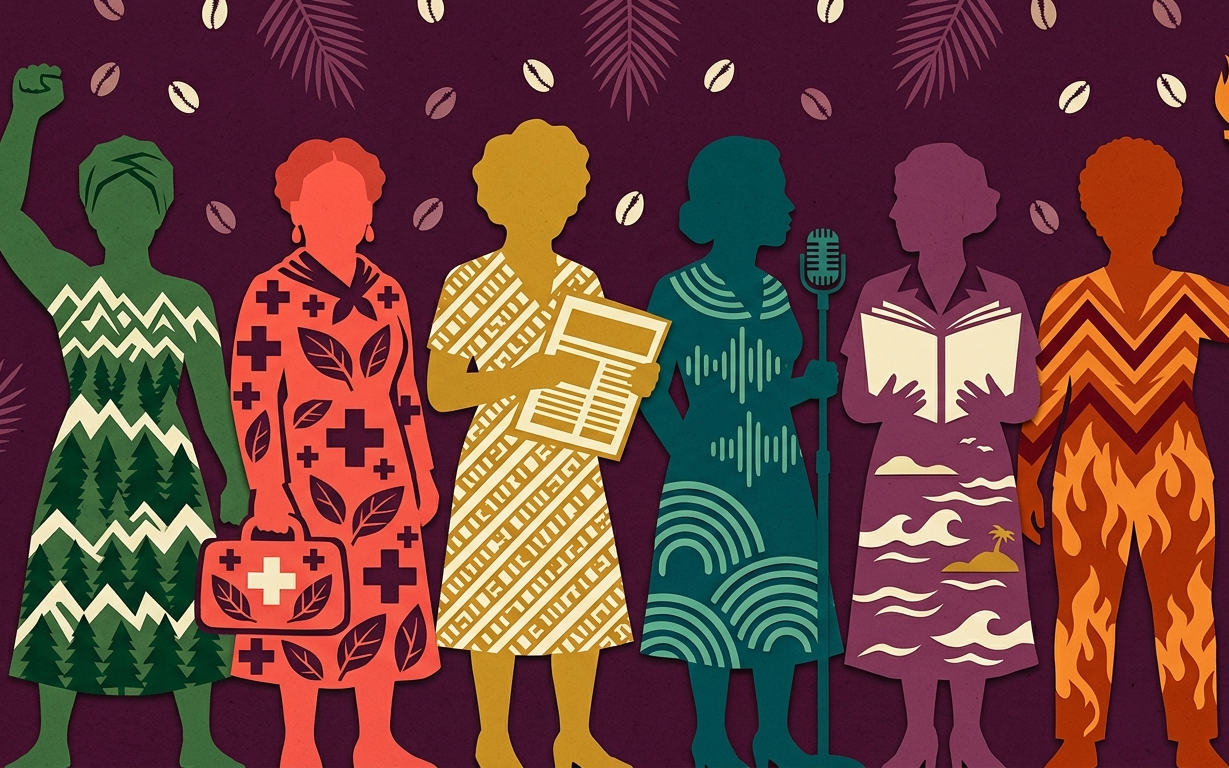
But invisible in the record does not mean absent from history. Nanny of the Maroons commanded armies when no woman in Europe was permitted to vote. Mary Seacole established a field hospital in an active war zone when the British army told her she was unwanted. Claudia Jones built a newspaper and a carnival from deportation and poverty in a country that had not chosen to receive her. Una Marson created a radio programme from the BBC that connected thousands of West Indian men fighting in a war with the families who might never see them again. These things happened. They were real. The record simply chose, for a very long time, not to notice.
History didn’t forget these women. History was written by people who decided they didn’t need to be included. We are rewriting that decision.
Nanny of the Maroons: National Hero of Jamaica
the Maroons
The first thing to know about Nanny of the Maroons is that we do not know everything about her. Her exact birth date is unknown. The precise year of her death is unknown. The details of her early life — believed, from strong oral historical tradition and some scholarly research, to have begun in West Africa, likely in a community related to the Ashanti/Akan people of present-day Ghana — are not fully documented in the colonial record. This is not surprising. The colonial record was not designed to preserve the histories of enslaved and formerly enslaved Africans, and the people most committed to preserving Nanny’s memory were Maroon communities whose history was oral, not written, and who had every reason to be suspicious of institutions that kept records.
What we know with confidence is this: Nanny was the military and spiritual leader of the Windward Maroons — communities of formerly enslaved Africans who had escaped from Jamaican plantations and established free settlements in the Blue Mountains of Jamaica’s eastern interior. These communities were not passive refugees. They were organised, disciplined, and formidably resistant. For approximately two decades in the early 18th century — a period historians broadly place in the 1720s through the 1740s — the Windward Maroons under Nanny’s leadership fought a sustained guerrilla campaign against the British colonial forces that is known as the First Maroon War. The Maroons used the mountainous terrain with extraordinary tactical skill, launching raids on plantations, retreating into forest that the British forces could not effectively navigate, and consistently outmanoeuvring an organised professional army with a force of formerly enslaved people who had no formal military training beyond what they had built themselves.
Nanny’s Town — her settlement in the Blue Mountains — became a symbol of organised Black freedom in the Caribbean at a time when the entire colonial apparatus was structured to make such freedom unimaginable. The settlement accepted and sheltered escaped enslaved people. Jamaican oral tradition and the accounts of Maroon descendants credit Nanny with personally organising the escape of more than 800 enslaved people over her lifetime — each one brought to the Maroon community, given freedom, and incorporated into a society that the plantation system could not touch.
The British, unable to defeat the Maroons militarily, eventually negotiated. The Peace Treaty of 1740 between the British colonial government and the Windward Maroons formally recognised the Maroons’ freedom and their right to their land — a significant concession that came nearly a century before the general abolition of slavery in the British Caribbean. That treaty exists because of the military reality that Nanny and her community had created: freedom taken, held, and defended until the colonial power was compelled to acknowledge it.
In 1976, the Government of Jamaica declared Nanny of the Maroons a National Hero — the only woman among the seven people formally honoured with that distinction. Her portrait appears on the Jamaican $500 note. The Maroon community at Moore Town in Portland parish continues to honour her memory, and the oral history of her life — preserved across generations with remarkable consistency — is now being documented by scholars working with Maroon communities to ensure that what the colonial archive failed to record does not disappear.
There is a specific element of Nanny’s historical portrait that deserves attention precisely because it is contested: the spiritual and legendary dimensions of her story, which describe her as possessing extraordinary powers — the ability to catch bullets and return them to the enemy being the most famous. These accounts appear consistently in Maroon oral tradition. They should be understood not as literal history but as the language in which a community describes a person whose reality exceeded what ordinary language could contain — the same function that legend always serves for people who produced an extraordinary life. The documented record of her military effectiveness is remarkable enough.
Leader, First Maroon War (1720s–1740s)
Freed 800+ enslaved people
Peace Treaty with Britain (1740)
Jamaican $500 note
Founded Nanny’s Town, Blue Mountains
Windward Maroons Commander
Mary Seacole: The Nurse the British War Office Turned Away — Who Went Anyway
Mary Jane Grant was born in Kingston, Jamaica, in 1805, the daughter of a Jamaican woman who ran a boarding house and practised traditional medicine, and a Scottish army officer. From her mother she learned both the hospitality trade and the healing arts — the Jamaican folk medicine tradition that combined West African botanical knowledge with whatever European techniques were available. She married Edwin Horatio Hamilton Seacole in 1836; he died in 1844, and the period of widowhood that followed was one of the most active and formative of her extraordinary life.
Before she ever reached the Crimea, Mary Seacole had already demonstrated a calibre of skill and courage that should have made her indispensable to any medical establishment willing to look clearly at what she could do. She treated cholera patients in Kingston during the Jamaican cholera epidemic of 1850. She crossed to Panama in 1851, where she ran a hotel for the gold-rush travelers flooding through Colón and treated patients during the devastating cholera epidemic in Panama, including performing a post-mortem examination on a cholera victim to study the disease — an act requiring significant scientific confidence and nerve. She returned to Jamaica and treated patients during the yellow fever epidemic of 1853. She had built, through her own observation, travel, and practice, a medical knowledge that most formally trained practitioners of her era could not match.
When the Crimean War began in 1854 and news of the catastrophic medical conditions facing British troops reached London, Seacole did what her experience and ability told her was the obvious thing: she applied to go. She approached the War Office and was rejected. She applied to the Crimean Fund — the committee organising nursing volunteers — and was rejected. She wrote to Florence Nightingale’s own circle and was rejected. The reasons given were never officially recorded as racial, but Seacole herself was clear about her understanding of why four separate applications by a woman of mixed Jamaican heritage were declined in sequence.
She funded her own passage to the Crimea.
At Balaclava, near the front lines, she built and ran the “British Hotel” — a boarding house, supply store, and medical facility that she funded herself and ran with her business partner Thomas Day. She treated wounded soldiers on the battlefield itself, sometimes under fire, providing medical care, food, and the particular mixture of practical competence and human warmth that soldiers, then as now, needed as much as any bandage. The soldiers called her “Mother Seacole.” They voted for her. They knew what she had done for them, and they said so publicly and repeatedly.
She was awarded the Crimean Medal, the French Légion d’honneur, and the Turkish Order of the Medjidie. She returned from Crimea virtually bankrupt — the British Hotel’s stock was unsellable after the war ended abruptly — and was the subject of a fundraising gala in London, attended by thousands of veterans who had not forgotten her.
In 1857 she published Wonderful Adventures of Mrs. Seacole in Many Lands — one of the earliest autobiographies published in Britain by a Black woman, and a remarkable document: clear-eyed, witty, strategically self-aware about race and gender, and utterly without self-pity. It was widely reviewed and well-received at the time, then largely forgotten for over a century. Its rediscovery in the late 20th century has been part of the broader recovery of her reputation, which now includes a statue outside St Thomas’ Hospital in London — the first public statue of a named Black woman in the United Kingdom, unveiled in 2016 — and her consistent appearance in surveys of the most admired figures in British history.
— Mary Seacole, Wonderful Adventures of Mrs. Seacole in Many Lands (1857)
French Légion d’honneur
Turkish Order of the Medjidie
First Black women’s autobiography published in Britain (1857)
Treated cholera in Jamaica and Panama
First public statue of a named Black woman in the UK (2016)
British Hotel, Balaclava — self-funded field hospital
Claudia Jones: The Woman Who Turned Deportation into a Carnival
Claudia Vera Cumberbatch was born on February 21, 1915, in Belmont, Port of Spain, Trinidad. Her family emigrated to New York when she was a child — around 1924 — and the Harlem in which she grew up during the Depression was a city within a city: politically electrified, culturally explosive, acutely conscious of race and class, and producing an entire generation of Caribbean-descended thinkers and activists who would shape the 20th century. Claudia Jones became one of the most consequential of them.
She joined the Communist Party USA and became one of its most prominent organisers and journalists — writing with clarity and force about the interlocking oppressions of race, class, and gender at a time when most political movements were willing to consider only one of the three. Her 1949 essay “An End to the Neglect of the Problems of the Negro Woman” is one of the founding documents of what would later be called intersectionality: an argument that Black women faced a compound oppression that could not be reduced to either racism or sexism alone and that the left’s failure to centre their experience was both a political and a moral failure.
For this, and for her Communist Party membership, she was arrested four times between 1948 and 1955 under the Smith Act — the legislation used to criminalise political dissent in Cold War America. She was imprisoned at Alderson Federal Prison in West Virginia in 1955, where her health — already damaged by years of poverty and stress — deteriorated severely. She had suffered from tuberculosis since childhood. Prison made it worse. In December 1955, rather than facing another term of imprisonment, she was deported to Britain: a country she had never lived in, that had not chosen to receive her, and that was in the middle of its own racial crisis.
In London, she built everything again from nothing. She founded the West Indian Gazette and Afro-Asian Caribbean News in 1958 — Britain’s first major Black newspaper, which she edited and largely wrote herself, using it as a platform for civil rights journalism, international solidarity, and Caribbean community organising. Then, in direct response to the 1958 Notting Hill race riots — a week of organised violent attacks on the West Indian community of North London — she organised the first Caribbean Carnival in Britain.
Held at St Pancras Town Hall in London on January 30, 1959, the event was not primarily an entertainment. It was a political statement: we are here, we are not going anywhere, and our culture is magnificent enough to fill a concert hall and invite the whole city to witness it. The event featured Caribbean musicians, dancers, Carnival queens, and the kind of communal joy that is itself a form of resistance. It was broadcast on the BBC. Jones organised similar events for the next several years, building a tradition that would outlast her.
Claudia Jones died on December 24, 1964, aged 49, of heart failure in her London flat — her body worn out by tuberculosis, imprisonment, deportation, and the relentless demands of building two major institutions from scratch in two different countries while in poor health. She was buried at Highgate Cemetery in London, to the left of Karl Marx’s grave. The Notting Hill Carnival that now brings a million people to the streets of West London every August Bank Holiday weekend is the direct descendant of what she started in 1959. She is almost never mentioned in the mainstream accounts of Notting Hill Carnival’s history. That is the erasure this post exists to correct.
Founded first Caribbean Carnival in Britain (1959)
Intersectional feminist theory (1949)
Imprisoned under the Smith Act, 1955
Mother of Notting Hill Carnival
Buried at Highgate Cemetery, London
Pan-African and anti-colonial organiser
Una Marson: The Jamaican Who Launched Caribbean Literature from a BBC Radio Booth
Una Maud Victoria Marson was born on February 6, 1905, in Santa Cruz, St Elizabeth, Jamaica, the daughter of a Baptist minister. She was educated at Hampton School in Jamaica and became, in her twenties, a journalist, editor, and publisher — founding and editing two Jamaica-based magazines, The Cosmopolitan (1928) and later working with the Jamaica Critic. She was an activist for women’s rights in Jamaica long before she became famous in Britain, founding the Jamaica Save the Children Fund and the Jamaica Women’s League — organisations working on precisely the kinds of issues that concerned her throughout her life: the welfare of women and children, access to education, and the dignity of Jamaican people.
She arrived in London in the early 1930s and entered a world that was simultaneously fascinated by and dismissive of Black intellectual and cultural life. She became involved in Pan-African networks centred around figures like C.L.R. James and George Padmore, and found herself at the intersection of multiple converging movements: Caribbean nationalism, Pan-Africanism, Black feminism, and the international solidarity movements of the interwar period. In 1936–1937, she served as the personal secretary and assistant to Emperor Haile Selassie of Ethiopia during his exile in London following the Italian invasion of Ethiopia — one of the most significant political events in the Pan-African world of that decade.
At the BBC, where she began working during World War II, she became the first Black woman programme maker in the corporation’s history. Her programme Calling the West Indies, launched in 1943, was a radio broadcast that connected West Indian servicemen stationed in Britain with their families back home in the Caribbean — an act of human connection in wartime that the BBC had not thought to provide until Marson created it. The programme was an immediate and profound success. The men fighting in a war their families could barely imagine, and the families waiting in Jamaica and Barbados and Trinidad for news — Una Marson made the connection.
But her most lasting institutional contribution was her role in shaping and editing Caribbean Voices — the BBC radio programme that became the most important single platform for Caribbean literature in the 20th century. Caribbean Voices, which ran from 1943 to 1958, broadcast the poetry and prose of Caribbean writers to audiences across the region and the diaspora, creating the first mass audience for Caribbean literary work and launching the careers of writers who would define the Caribbean literary canon. Among the writers whose work first reached significant audiences through Caribbean Voices were V.S. Naipaul, Sam Selvon, George Lamming, Derek Walcott, and Edgar Mittelholzer. Una Marson was the person who built the stage on which they stood.
She returned to Jamaica in the 1950s and continued working in broadcasting and women’s rights advocacy until her death on May 6, 1965, in Kingston. She was 60 years old. The BBC has a plaque commemorating her. The Nobel laureates and award-winning novelists whose careers she helped build are considerably better remembered than she is. That imbalance is precisely what this post addresses.
Created “Calling the West Indies” (1943)
Editor, Caribbean Voices — launched Naipaul, Selvon, Lamming
Personal secretary to Emperor Haile Selassie (1936–37)
Founder, Jamaica Women’s League
Poet: Tropic Reveries (1930), Heights and Depths (1931)
Pan-Africanist and Jamaica feminist pioneer
Jean Rhys: The Dominican Who Rewrote Jane Eyre — and Changed Literature Forever
Ella Gwendolen Rees Williams was born on August 24, 1890, in Roseau, Dominica, the daughter of a Welsh doctor and a Dominican Creole woman. She left Dominica for England as a teenager, studied briefly at the Academy of Dramatic Art in London, and spent much of her early adult life in Europe — in England, France, and Holland — living the precarious, semi-bohemian existence that would become the raw material for her fiction. She published four novels in the 1930s: Quartet (1928), After Leaving Mr Mackenzie (1931), Voyage in the Dark (1934), and Good Morning, Midnight (1939). All four were critically noted; none achieved wide commercial success. After the Second World War, she disappeared almost entirely from public life for over two decades, living in rural England, writing in obscurity, assumed by many in the literary world to be dead.
Then, in 1966, at the age of 75, she published Wide Sargasso Sea.
The novel is a prequel to Charlotte Brontë’s Jane Eyre — but calling it that risks understating its ambition and its effect. Brontë’s novel contains, famously, the figure of Bertha Mason: Mr Rochester’s “mad” first wife, locked in the attic of Thornfield Hall, described in terms of animalistic violence, reduced to a symbol of dangerous, uncontrollable otherness, and ultimately destroyed by fire. She has no interiority in the original novel. She is not a person; she is an obstacle, a Gothic plot device, a thing to be contained and then removed so the English romance can proceed.
Rhys gave her everything Brontë had denied her. She renamed her Antoinette Cosway, made her Creole Caribbean — like Rhys herself — and told the story of her life: the colonial Caribbean childhood, the dissolution of a Creole society that fit neither white European nor Black Jamaican categories fully, the marriage to a cold Englishman who renamed her “Bertha” as an act of erasure, the transportation to England, the slow destruction of a woman who had lost every world that had ever held her. Wide Sargasso Sea is one of the foundational texts of postcolonial literature — the novel that demanded the literary canon ask itself whose story it had been telling all along, and whose it had been deliberately not telling.
Rhys won the WH Smith Literary Award in 1967 for Wide Sargasso Sea. The novel has never gone out of print. It is on university syllabuses around the world. It has reshaped how a generation of scholars and readers approaches Jane Eyre, Victorian literature, and the question of whose inner life fiction is entitled to represent. All of this from a Dominican Creole woman who spent thirty years in literary obscurity, writing alone in a cold cottage in the English countryside, carrying an entire Caribbean world inside her.
— Jean Rhys, Wide Sargasso Sea (1966)
Voyage in the Dark (1934)
Good Morning, Midnight (1939)
Foundational postcolonial literature text
First Caribbean woman in Western literary canon
Born Roseau, Dominica, 1890
Rewrote Bertha Mason — gave voice to the erased
Audre Lorde: The Caribbean Voice at the Centre of American Feminism
Audrey Geraldine Lorde was born on February 18, 1934, in New York City, to parents who had immigrated from the Caribbean: her mother, Linda Belmar, from Grenada, and her father, Frederick Byron Lorde, from Barbados. She grew up in Harlem, was legally blind as a child, and learned to read by memorising poems her mother recited aloud before she could see the page well enough to read them herself. This is, if one were looking for a metaphor, a perfect one: a child who could not quite see the words, but who carried them inside her anyway.
She described herself throughout her life as a “Black lesbian feminist warrior poet” — a formulation that was both political claim and literary programme, insisting on the indivisibility of all the things she was, in an era when most institutions wanted her to be one thing at a time and preferably none of them simultaneously. Her Caribbean heritage was not incidental to this identity. The Grenadian and Barbadian world of her parents — its particular forms of strength, its oral culture, its relationship to colonialism and survival — ran through her work and her life.
Her poetry is among the most powerful written in 20th-century America. Coal (1976) established her as a major voice. The Black Unicorn (1978) — drawing explicitly on West African Yoruba mythology, reaching back through the Caribbean to Africa for its symbolic vocabulary — is widely regarded as her masterwork in poetry: a book that demonstrates, in its imagery and its ambition, exactly what kind of deep roots Caribbean-descended people carry. The Cancer Journals (1980), written after her diagnosis with breast cancer, is one of the most honest and important accounts of illness, embodiment, and survival ever written. Zami: A Biomythography (1982) is a genre-defying memoir-novel about her Caribbean-heritage girlhood, her sexual identity, and her development as a poet. Sister Outsider (1984), her essay collection, contains “The Master’s Tools Will Never Dismantle the Master’s House” — an essay that has been cited so many times across so many disciplines that it has become something close to canonical text in feminist, postcolonial, and critical theory.
In 1989, she won the National Book Award for A Burst of Light. In 1991, she was named New York State Poet Laureate. In 1980, she co-founded Kitchen Table: Women of Color Press with Barbara Smith — the first publisher in the United States specifically dedicated to books by women of colour, which created platforms for writers who the mainstream publishing industry had consistently declined to make room for.
Audre Lorde died on November 17, 1992, in St Croix, US Virgin Islands — the Caribbean claimed her at the end — of liver cancer. She was 58 years old. She left behind a body of work that has shaped academic feminism, Black literary studies, LGBTQ+ rights advocacy, and poetry in the United States and worldwide. She also left behind, in every piece of her work, the specific texture of a Caribbean-descended New York girlhood: the cadences her mother used, the survival knowledge carried across the Atlantic from Grenada and Barbados, the particular quality of care and fierceness that Caribbean parenthood pressed into its American children.
New York State Poet Laureate (1991–92)
The Black Unicorn (1978)
Sister Outsider (1984)
Co-founded Kitchen Table: Women of Color Press (1980)
“The Master’s Tools Will Never Dismantle the Master’s House”
Grenadian and Barbadian parentage
More Women Who Changed History — and Deserve to Be Known by Name
What These Women Have in Common — and What Their Erasure Tells Us
Every woman on this list operated at the intersection of at least two marginalised identities — Black and woman, or Caribbean and woman, or poor and woman, or some combination of all three and more — and in every case, the systems that controlled historical narration were operated by people who considered themselves the primary subjects of history. Colonial administrators wrote about themselves. British military historians wrote about British military history. Male nationalist historians wrote about male nationalists. Literary critics trained in the European tradition wrote about the European tradition.
The women on this list were not absent from the events their histories describe. Nanny of the Maroons was not a footnote in the First Maroon War — she was its military architect. Mary Seacole was not a supporting character in the Crimean War — she ran a field hospital on its front lines. Claudia Jones did not attend Notting Hill Carnival — she created it from nothing. Una Marson did not listen to Caribbean Voices — she built the platform it broadcast from. The presence was always there. The record chose not to see it.
What changes when we restore these stories to their proper place is not just the historical record — though the historical record is important. What changes is the imagination of what is possible. Every Caribbean girl who learns that Nanny of the Maroons commanded an army in the mountains of Jamaica is offered a different image of what Caribbean women have been — and therefore, of what they can be. Every reader who encounters Jean Rhys giving Antoinette Cosway a voice learns something about whose inner life literature is supposed to represent. Every student who learns that Claudia Jones built Notting Hill Carnival from deportation and poverty understands something new about what resilience actually looks like as a practice.
Representation in history is not sentiment. It is infrastructure. It builds the structures through which the next generation understands what the world contains, what they might do in it, and who is entitled to be remembered for doing it.
Frequently Asked Questions: Caribbean Women in History
Who was Nanny of the Maroons?
Nanny of the Maroons was an 18th-century military and spiritual leader of the Windward Maroons of Jamaica — free communities of formerly enslaved Africans established in the Blue Mountains. Believed to be of Ashanti/Akan origin from West Africa, she led the Windward Maroons during the First Maroon War against British colonial forces in the 1720s through 1740s. A peace treaty between the Windward Maroons and the British was signed in 1740. Oral tradition credits her with personally securing the freedom of more than 800 enslaved people. Jamaica declared her a National Hero in 1976 — the only woman among seven — and she appears on the Jamaican $500 note.
Who was Mary Seacole?
Mary Seacole was born Mary Jane Grant in Kingston, Jamaica, in 1805, the daughter of a Jamaican woman who practised traditional medicine and a Scottish army officer. She treated patients during cholera outbreaks in Jamaica and Panama before travelling to the Crimean War (1855), where she had been rejected by the British War Office and the nursing committee. She funded her own passage to Crimea and established the “British Hotel” near Balaclava — a boarding house, supply store, and medical facility. She treated wounded soldiers on the battlefield, was awarded the Crimean Medal, the French Légion d’honneur, and the Turkish Order of the Medjidie, and published one of the first British Black women’s autobiographies in 1857. A statue of her stands outside St Thomas’ Hospital in London — unveiled in 2016, the first public statue of a named Black woman in the UK.
Who was Claudia Jones?
Claudia Jones was born Claudia Vera Cumberbatch on February 21, 1915, in Belmont, Port of Spain, Trinidad. She migrated to New York and became a prominent Communist Party USA organiser and journalist, repeatedly arrested under the Smith Act. Imprisoned in 1955, she was deported to Britain in December of that year. In London she founded the West Indian Gazette (1958) — Britain’s first major Black newspaper — and organised the first Caribbean Carnival in Britain at St Pancras Town Hall on January 30, 1959, in direct response to the 1958 Notting Hill race riots. She died on December 24, 1964, aged 49, and is buried at Highgate Cemetery. She is known as the Mother of Notting Hill Carnival.
Who was Una Marson?
Una Marson was born February 6, 1905, in Santa Cruz, St Elizabeth, Jamaica. She was the first Black woman programme maker at the BBC, where she created “Calling the West Indies” (1943) — a wartime radio programme connecting West Indian servicemen in Britain with their families — and served as editor of “Caribbean Voices,” the BBC radio programme that launched the literary careers of V.S. Naipaul, Sam Selvon, George Lamming, and other major Caribbean writers. She was also a poet, feminist, and activist in Jamaica, and served as personal assistant to Emperor Haile Selassie during his London exile in 1936–1937. She died May 6, 1965, in Kingston.
What did Audre Lorde contribute to literature and feminism?
Audre Lorde (1934–1992) was born in New York to parents from Grenada and Barbados. A poet, essayist, and activist who described herself as a “Black lesbian feminist warrior poet,” she won the National Book Award for A Burst of Light (1989) and was named New York State Poet Laureate in 1991. Her essay collection Sister Outsider (1984) contains “The Master’s Tools Will Never Dismantle the Master’s House” — one of the most cited essays in feminist and postcolonial theory. She co-founded Kitchen Table: Women of Color Press in 1980. Her poetry collection The Black Unicorn (1978), which drew on West African Yoruba mythology, is widely regarded as her masterwork.
Who was Jean Rhys and what did she write?
Jean Rhys was born Ella Gwendolen Rees Williams on August 24, 1890, in Roseau, Dominica. Of Welsh and Dominican Creole heritage, she published four novels in the 1930s before falling into literary obscurity. In 1966, at age 75, she published Wide Sargasso Sea — a postcolonial prequel to Charlotte Brontë’s Jane Eyre told from the perspective of Bertha Mason, reimagined as a Creole Caribbean woman named Antoinette Cosway. The novel won the WH Smith Literary Award in 1967, has never gone out of print, and is considered one of the foundational texts of postcolonial literature. She died in Exeter, England, in 1979.
Who was the first female Prime Minister of the Caribbean?
Mary Eugenia Charles of Dominica was the first woman to serve as Prime Minister of a Caribbean nation. She was elected in 1980 and served three consecutive terms, stepping down in 1995 after fifteen years in office. A barrister and co-founder of the Dominica Freedom Party, she was known as “The Iron Lady of the Caribbean” and led Dominica’s recovery from the devastating Hurricane David of 1979. She died in 2005.
This list is not exhaustive. For every name here there are twenty more — women who led slave revolts and women who wrote the first newspapers; women who crossed oceans and women who refused to leave their island; women who were deported and women who stayed; women whose work the canon ignored for a century and women whose work has still never been collected in a single volume.
The work of saying their names is not finished. It has barely started. But it starts here, and it starts with these:
Jean Rhys. Audre Lorde. Calypso Rose. Eugenia Charles.
Sanité Bélair. Grace Nichols. Merle Hodge. Louise Bennett-Coverley.
And every woman who carried a world inside her that the record did not bother to write down.
◆ Say their names. Keep saying them. ◆