Why the Caribbean Diaspora Is Different from Every Other Diaspora Story
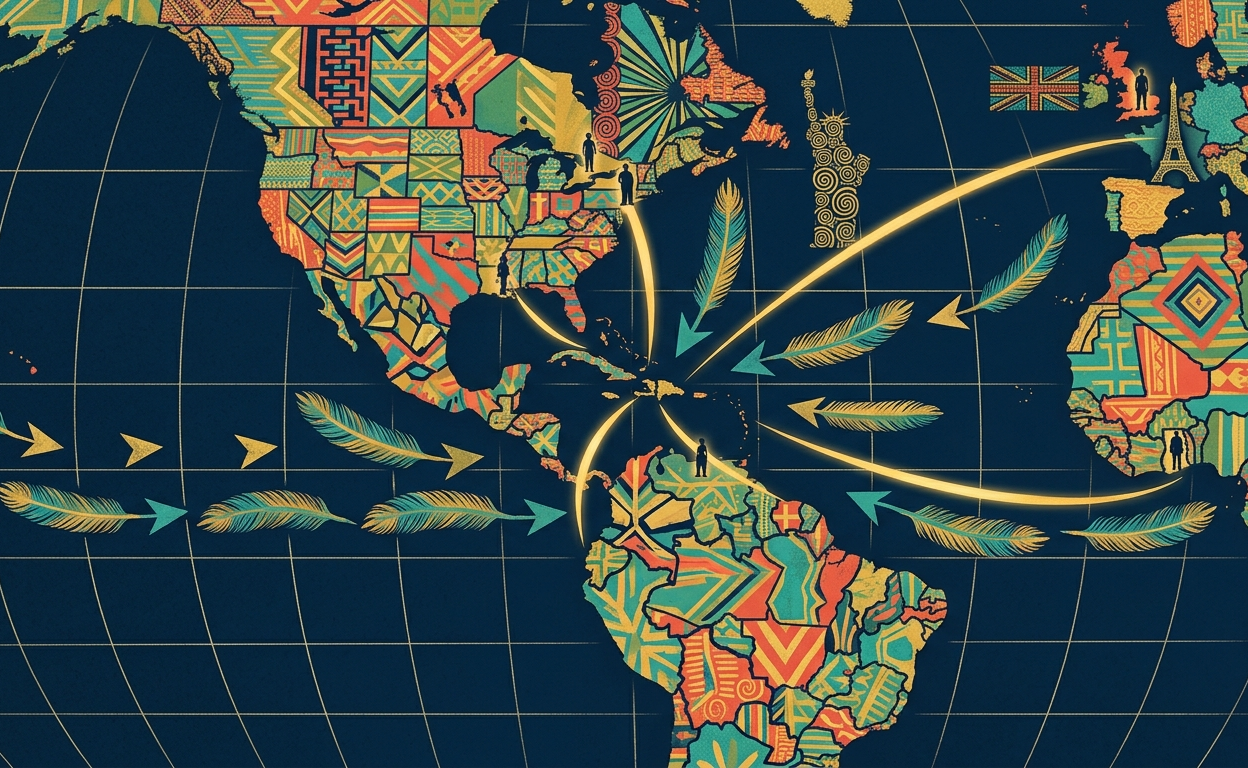
Every major diaspora in human history has a founding cause. For the Jewish diaspora, it was expulsion and persecution across millennia. For the Irish diaspora, it was famine and poverty under colonial rule. For the South Asian diaspora, it was the same colonial labour system — indentureship — that shaped the Caribbean itself. What distinguishes the Caribbean diaspora from nearly all of these is the sheer multiplicity of its layers and the extraordinary degree to which it was shaped, from the very beginning, by forced displacement rather than chosen migration.
The enslaved Africans who built the Caribbean did not choose to go there. The Indian indentured labourers who arrived after Emancipation made a choice constrained to near-impossibility by poverty and colonial power. And then, when the Caribbean’s own people began to leave — for London, for New York, for Toronto, for Amsterdam — they were often leaving in search of the education and opportunity that the colonial system had built in its metropoles and withheld from its peripheries. The diaspora was not simply a scattering. It was a third and fourth and fifth wave of displacement, each wave making the Caribbean presence in the world broader, deeper, and more consequential.
What is remarkable — what is, when you look at it clearly, genuinely astonishing — is what Caribbean people built in the places they arrived. Not in spite of the conditions of their arrival, but often because of the particular combination of intellectual tradition, political consciousness, cultural richness, and hardened resilience that the Caribbean itself had developed. The Caribbean created people who were, by the time they reached New York or London or Paris or Toronto, prepared to change the world. Not because Caribbean people are inherently exceptional — no people are inherently exceptional — but because the history of the Caribbean had produced a specific kind of preparation: a people who had seen colonialism clearly from inside it, who had built everything from nothing multiple times, and who understood, in their bones and in their language and in their music and in their food, that survival and creativity were not separate things.
The Caribbean didn’t just produce people who changed the world. It produced people who understood why the world needed to change — and knew from direct experience what it was being changed from.
Marcus Garvey and the Largest Black Mass Movement in History
Marcus Mosiah Garvey was born on August 17, 1887, in Saint Ann’s Bay, Saint Ann, Jamaica. He received a basic formal education, worked as a printer’s apprentice, and by his early twenties had already begun a journey of self-education and political awakening that would take him across Central America, London, and eventually to New York — where, from 1916 onward, he built the most extraordinary Black political organisation the world had ever seen.
The Universal Negro Improvement Association (UNIA), which Garvey had founded in Jamaica in 1914 before transferring its base of operations to Harlem, became at the height of its influence in the early 1920s the largest Black mass movement in history. At its peak, UNIA had chapters in more than 40 countries, a membership estimated in the hundreds of thousands to millions, a weekly newspaper — the Negro World — that was distributed across the Americas, Africa, and the Caribbean, and a shipping company, the Black Star Line, conceived as the material infrastructure of Black economic independence. The UNIA’s 1920 Convention in Harlem — the first International Convention of the Negro Peoples of the World — drew 25,000 delegates from across the diaspora to Madison Square Garden.
Garvey’s philosophy was Pan-Africanism of the most radical kind: not integration into white American or British society, but the development of independent Black institutions, economies, and ultimately a return to and rebuilding of Africa as a sovereign homeland for the global African diaspora. His influence was not limited to the people who joined his organisation. Martin Luther King Jr. — whose own father was inspired by Garvey — said Garvey was “the first man on a mass scale and in the modern period” to give Black people a sense of dignity and destiny. Malcolm X‘s father, Earl Little, was a Garveyite organiser. Kwame Nkrumah, the first President of independent Ghana, credited Garvey with his political awakening. Nelson Mandela kept Garvey’s writings. The entire arc of 20th-century Black liberation — from the civil rights movement to African independence to Caribbean nationalism — runs through the ideas that a printer’s apprentice from Saint Ann’s Bay, Jamaica brought to Harlem in 1916.
Garvey was convicted of mail fraud in 1923 in a case that many historians argue was politically motivated — the Justice Department had J. Edgar Hoover surveilling him as a potential subversive from 1919 onward. He was imprisoned at Atlanta Federal Penitentiary, then deported to Jamaica in 1927, never permitted to return to the United States. He eventually died in London on June 10, 1940, having never set foot on the African continent his philosophy had centred. Jamaica declared him a National Hero in 1964 — its first. His face is on the Jamaican $1 coin.
Black Star Line shipping company
Negro World newspaper
First National Hero of Jamaica (1964)
Influenced MLK, Malcolm X, Nkrumah, Mandela
1920 Harlem Convention — 25,000 delegates
How Caribbean Writers and Thinkers Helped Build the Harlem Renaissance
Festus Claudius McKay was born on September 15, 1889, in Sunny Ville, Clarendon, Jamaica, the youngest of eleven children of a farming family. He moved to the United States in 1912 to study agriculture at Tuskegee Institute, transferred to Kansas State University, and eventually arrived in New York, where his poetry and his political consciousness found their full expression in the ferment of the Harlem Renaissance.
In the summer of 1919 — the year of the Red Summer, when anti-Black race riots erupted in dozens of American cities and White mobs killed hundreds of Black Americans — Claude McKay published the poem “If We Must Die.” Written in the Shakespearean sonnet form, it was a call to resistance of such concentrated fury and dignity that it entered the American consciousness immediately and permanently. It was read aloud in Black communities across the country. It was reprinted in newspapers and pamphlets. Decades later, Winston Churchill quoted it to the House of Commons during the Second World War — not knowing, or not saying, that it was written by a Jamaican man in response to racial pogroms in American cities. The poem is one of the most powerful ever written in the English language, and its author was from Clarendon, Jamaica.
— Claude McKay, “If We Must Die” (1919)
McKay’s novel Home to Harlem (1928) became the first novel by a Black author to reach the New York Times bestseller list. His subsequent novels — Banjo (1929), set among Black expatriates in Marseille, and Banana Bottom (1933), set in Jamaica — further established him as one of the most important literary voices of the 20th century. He lived, depending on the period, in Britain, France, the Soviet Union (which he visited in 1922), and Morocco — his life a testament to the global mobility and cultural breadth that Caribbean intellectuals brought to every world they entered.
Claude McKay was not alone. The Caribbean contribution to the Harlem Renaissance was substantial and deliberate. Eric Walrond, born in Georgetown, British Guiana (now Guyana) in 1898 and raised partly in Barbados and Panama, published Tropic Death (1926) — a collection of stories about Caribbean working-class life that brought a specifically Caribbean literary sensibility to the Renaissance’s project of documenting and celebrating Black life. Walrond served as managing editor of Garvey’s Negro World. W.A. Domingo (Wilfred Adolphus Domingo), born in Kingston, Jamaica in 1889, was a socialist journalist who contributed to multiple Harlem Renaissance publications and was an important voice in the political debates of the era. The Harlem Renaissance, often narrated as an American story, was from its foundations a Caribbean-American story.
Home to Harlem (1928) — first Black author NYT bestseller
Banana Bottom (1933)
Born Clarendon, Jamaica, 1889
C.L.R. James: The Trinidadian Who Wrote the Definitive History of the Haitian Revolution
Cyril Lionel Robert James was born on January 4, 1901, in Tunapuna, Trinidad, to a schoolteacher family. He won a scholarship to Queen’s Royal College in Port of Spain — Trinidad’s premier secondary school at the time — where he received a rigorous colonial education in British literature, history, and classics that he would spend the rest of his life both drawing on and systematically dismantling. He arrived in Britain in 1932 and began the career that would make him one of the most important intellectual figures of the 20th century.
The Black Jacobins: Toussaint L’Ouverture and the San Domingo Revolution (1938) is the book by which C.L.R. James is best remembered, and its reputation has only grown in the decades since publication. It is the definitive scholarly account of the Haitian Revolution — the uprising of enslaved Africans in the French colony of Saint-Domingue that, between 1791 and 1804, produced the world’s first Black republic and defeated, in sequence, the French, Spanish, and British armies, including the 40,000-man expeditionary force Napoleon sent to reassert French control. James’s achievement was not merely to document these events — which European historiography had largely ignored or dismissed — but to place them in the full context of Atlantic capitalism and the transatlantic slave trade, and to argue that the Haitian Revolution was not an aberration but a direct consequence of the Enlightenment ideas of liberty and human rights that European colonialism preached while practicing their opposite. The Black Jacobins is both a masterwork of historical scholarship and one of the most powerful anti-colonial arguments ever made.
James also wrote Beyond a Boundary (1963) — a book about cricket and Caribbean identity that is, without exaggeration, one of the greatest sports books ever written and one of the most penetrating analyses of colonialism ever published. Its opening question — “What do they know of cricket who only cricket know?” — is among the most famous sentences in 20th-century non-fiction. It argues that cricket, the sport the British exported to the Caribbean as a tool of colonial acculturation, was transformed by Caribbean players into an expression of anti-colonial assertion — and that understanding this transformation reveals everything essential about the Caribbean colonial encounter.
James’s intellectual range was extraordinary. He wrote on Marxist theory (World Revolution, 1937), on American culture, on African politics, and on the question of what socialist revolution actually meant in practice — engaging with Trotsky, Lenin, and the entire tradition of radical European thought while insisting, always, on the centrality of Caribbean and African experience to any adequate understanding of the modern world.
Beyond a Boundary (1963)
Pan-Africanist and Marxist theorist
Born Tunapuna, Trinidad, 1901
Influenced George Padmore, Kwame Nkrumah
Frantz Fanon: The Martinican Who Gave Anti-Colonialism Its Language
Frantz Omar Fanon was born on July 20, 1925, in Fort-de-France, Martinique, then as now a French overseas department. He studied medicine and psychiatry in France after serving in the Free French forces during the Second World War, and his medical training gave him the intellectual framework for what would become his most enduring contribution: an account of colonialism not merely as a political or economic system, but as a psychological wound — a form of violence done to the inner life of colonised people that was as real, as measurable, and as consequential as any physical harm.
Black Skin, White Masks (Peau noire, masques blancs, 1952) was Fanon’s first major work, written originally as his doctoral thesis. It examined, with the precision of a clinician and the urgency of a man who had experienced what he was describing, the psychological effects of colonialism: how colonised people are made to see themselves through the eyes of the coloniser, to internalise the coloniser’s contempt, to experience their own identity as something to be ashamed of or hidden. The book was a foundational text of what would become postcolonial theory, and it spoke directly to the experience of Caribbean people in a way that nothing written before it had quite managed to do.
The Wretched of the Earth (Les Damnés de la Terre, 1961), prefaced by Jean-Paul Sartre and published in the final months of Fanon’s life, went further. It was a manual of anti-colonial revolution — an argument that the violence of colonialism could only be undone through the transformative act of the colonised people taking their own liberation by force, and that the psychological as well as the political emancipation of colonised people required this act of agency. The book’s first chapter, “On Violence,” remains one of the most discussed and debated pieces of political theory in modern history.
Fanon had by the time of that book’s publication left Martinique permanently behind and committed himself to the Algerian revolution against French colonial rule, working as a psychiatrist at the Blida-Joinville Hospital in Algeria and eventually joining the Front de Libération Nationale (FLN) — the Algerian National Liberation Front — as both a propagandist and a diplomat, carrying the FLN’s cause to the attention of the newly independent African states. He died of leukemia on December 6, 1961, in Bethesda, Maryland — aged 36, having flown to the United States for experimental treatment — having lived long enough to know that Algeria would win its independence the following year but not long enough to see it. His work has influenced virtually every anti-colonial thinker and liberation movement from the 1960s to the present.
The Wretched of the Earth (1961)
Joined Algerian FLN revolution
Foundational postcolonial theory
Born Fort-de-France, Martinique, 1925
Died aged 36
Stokely Carmichael: The Trinidadian Who Coined “Black Power”
Stokely Carmichael was born on June 29, 1941, in Port of Spain, Trinidad, and moved with his family to Harlem in 1952 at the age of eleven. He grew up in New York, became politically active as a student at Howard University in Washington D.C., and in the early 1960s threw himself into the heart of the American civil rights movement — joining the Student Nonviolent Coordinating Committee (SNCC) and becoming one of its most effective and fearless organisers.
He was a Freedom Rider in 1961 — one of the activists who rode interstate buses through the American South to challenge the segregation of bus terminals, knowing they would face violent white mob attacks and arrest. He was arrested 27 times in total during his civil rights work. He organised voter registration drives in Alabama’s Lowndes County — one of the most dangerous places in America for Black political activity — and participated in the Selma to Montgomery marches of 1965.
In June 1966, during a march through Greenwood, Mississippi, Carmichael was arrested for the 27th time. When he was released and stepped up to address the waiting crowd, he said words that had been building in him for years: “We want Black Power.” The crowd, exhausted and furious and ready, repeated it back to him: Black Power. Black Power. The phrase was not new — it had appeared in various forms in Black political writing — but the moment gave it a currency and a reach it had never had before. It became the defining slogan of the second phase of the civil rights movement: the phase that asked not just for legal equality within existing structures, but for the political and economic power of Black communities to shape their own destinies.
Carmichael later became chairman of the Black Panther Party, then broke with it and moved, in 1969, to Guinea in West Africa, where he renamed himself Kwame Ture — taking the names of his two political heroes, Kwame Nkrumah of Ghana and Sékou Touré of Guinea. He spent the rest of his life in Guinea, continuing to organise and speak for Pan-Africanism. He died in Conakry on November 15, 1998. His last public words, in the weeks before his death from prostate cancer, were characteristically undimmed: “Organise. Organise. Organise.”
Freedom Rider (1961) — arrested 27 times
SNCC organiser and chairman
Black Panther Party chairman (briefly)
Born Port of Spain, Trinidad, 1941
Renamed Kwame Ture in Guinea, 1969
Stuart Hall: The Jamaican Who Invented Cultural Studies
Stuart Hall was born on February 3, 1932, in Kingston, Jamaica, into a middle-class family navigating the complexities of colonial Jamaican society with its intricate hierarchies of colour and class. He won a Rhodes Scholarship to Merton College, Oxford, in 1951, and never permanently returned to Jamaica — spending his life in Britain as one of the most consequential intellectual figures British academia has produced in the 20th century.
Hall was a founding editor of the New Left Review (1960) and one of the key intellectuals who shaped the British New Left in the late 1950s and 1960s. At the Centre for Contemporary Cultural Studies at the University of Birmingham, which he joined in 1964 and directed from 1968 to 1979, he helped build Cultural Studies as an academic discipline — an interdisciplinary field that drew on literary theory, sociology, anthropology, and political economy to understand how culture functions as a site of power, ideology, and resistance.
His theoretical contributions are too numerous to summarise briefly, but three stand out. His work on encoding/decoding — the idea that media messages are encoded with dominant meanings but decoded by audiences in multiple ways — transformed media studies. His work on representation — how images and texts produce meanings about identity, race, and difference — shaped visual culture studies and continues to dominate the field. And his theoretical work on diaspora identity — particularly the essays collected in Cultural Identity and Diaspora (1990) — offered the most sophisticated account available of what it means to belong to a people scattered across the world by colonialism, to have an identity that is “not already accomplished” but constantly in production.
Hall’s Jamaican origins were not incidental to his intellectual work — they were its engine. The particular experience of being in but not of British society, of navigating the gap between a colonial education and a colonial reality, of belonging simultaneously to a Caribbean world and a British intellectual world without fully belonging to either — this was the experiential ground from which his most important theoretical insights grew. He is the intellectual who most completely turned the Caribbean experience of displacement and multiplicity into a framework for understanding the modern world.
Founding editor, New Left Review (1960)
Cultural Identity and Diaspora (1990)
Encoding/Decoding theory
Born Kingston, Jamaica, 1932
Rhodes Scholar, Oxford, 1951
The Windrush Generation: Caribbean Britain and the Making of a Multicultural Nation
On the morning of June 22, 1948, the HMT Empire Windrush docked at Tilbury in Essex, carrying 492 passengers from Jamaica and other Caribbean islands. Among them was Lord Kitchener — the Trinidadian calypsonian — who filmed a newsreel segment on the gangplank singing “London Is the Place for Me,” composing it, by his own account, on the voyage. The footage is one of the most celebrated and most viewed documents of Caribbean cultural confidence in the 20th century. The occasion was less celebrated by the British government, which received an urgent memo from eleven Labour MPs warning that the Caribbean migrants’ arrival would cause “social difficulties.”
The Caribbean migrants who came to Britain from 1948 through the 1950s and 1960s — the Windrush Generation — came at Britain’s own invitation. Britain was rebuilding after the Second World War and needed workers. The British Nationality Act of 1948 gave British subjects in the colonies the right to settle in the United Kingdom. Caribbean people exercised that right. They came to work in the National Health Service, on London Transport, in factories, in hospitals, in schools. They were legal, invited, and contributing. They built communities, raised children, paid taxes, and created the multicultural Britain that exists today.
The Windrush Scandal of 2018 revealed that the British government had been systematically denying the rights of Windrush generation people and their descendants — destroying landing cards, wrongly classifying people as illegal immigrants, detaining and deporting Caribbean British people who had lived legally in Britain for fifty or sixty years. People who had worked in the NHS for decades were denied cancer treatment because they could not prove citizenship. People who had paid taxes for forty years were told they had no right to be in the country. The scandal was a direct consequence of the government’s stated goal of creating a “hostile environment” for irregular migrants — a policy whose machinery could not distinguish between irregular migrants and the invited guests of a previous generation.
The Windrush Generation’s contribution to Britain is visible in every NHS ward, every London bus route, every multiracial British city. The scandal named for their ship is a reminder that the debt Britain owes to Caribbean people for that contribution has never been honestly reckoned with.
From Hamilton to Harris: The Caribbean Roots of American Political History
The Caribbean’s footprint in American political history is deeper than almost anyone acknowledges in the mainstream telling of that history. It begins, remarkably, with one of the Founding Fathers themselves.
Alexander Hamilton was born in Charlestown, on the island of Nevis, in the British Leeward Islands — the Caribbean. His birth year is disputed in the historical record (1755 or 1757 are both cited), but his Caribbean birth is not. He came to New York around 1772, became one of George Washington’s most trusted aides-de-camp during the Revolutionary War, was a principal author of the Federalist Papers (with James Madison and John Jay), and served as the first Secretary of the Treasury of the United States, creating the financial architecture of the American federal system. The national bank, the federal assumption of state debts, the customs revenue system — these are Hamilton’s work, and they came from a man born in the Caribbean. Lin-Manuel Miranda’s 2015 musical brought Hamilton’s Caribbean origins to mass public attention; the historical record had contained them for 250 years.
Two Nobel Prizes in Literature. One in Economics. One Extraordinary Island.
The highest per-capita Nobel Prize rate of any country in the world.
Derek Walcott (January 23, 1930 – March 17, 2017) was born in Castries, Saint Lucia. His Nobel citation called him a poet who “carries a double cultural heritage” — the Caribbean and the European literary tradition — and whose work holds them “in productive tension.” His epic poem Omeros (1990) transposes Homer’s Iliad to the fishing villages of Saint Lucia, giving the Caribbean the full weight of classical European literary recognition while insisting that its own stories required no European validation to be important. His poetry, plays, and essays constitute one of the most significant literary careers of the 20th century, and they are rooted in the specific landscape, history, and light of the Caribbean.
V.S. Naipaul (August 17, 1932 – August 11, 2018) was born in Chaguanas, Trinidad, the grandson of an Indian indentured labourer. He won the Nobel Prize in Literature in 2001. His novel A House for Mr Biswas (1961) — the story of a Trinidadian man of Indian descent struggling to own a house and thereby to own a life — is widely regarded as one of the great novels of the 20th century. Naipaul is a contested figure: his views on Africa, on Islam, and on the developing world were harshly criticised as contemptuous by many of the world’s postcolonial scholars and writers. The work and the man are both genuinely difficult to hold in a single frame, which is itself a kind of literary achievement.
Sir Arthur Lewis (January 23, 1915 – June 15, 1991) was born in Castries, Saint Lucia. He won the Nobel Prize in Economics in 1979 for his development of the dual-sector model of economic development — the “Lewis Model” — which argued that developing economies could grow by transferring surplus labour from traditional (agricultural) sectors to modern (industrial) sectors. The Lewis Model remains one of the most influential frameworks in development economics and has shaped economic policy in countries from South Korea to China to sub-Saharan Africa. Lewis was also the first Black person to win a Nobel Prize in a non-peace category.
The Nobel laureates are the most internationally visible, but the Caribbean literary tradition is far larger. Jamaica Kincaid, born Elaine Potter Richardson in Antigua, is among the most important living writers in English — her essay A Small Place (1988), a forty-page evisceration of colonial tourism in Antigua, is one of the finest pieces of political non-fiction of the century. Edwidge Danticat, born in Port-au-Prince, Haiti, and based in the United States, has won the National Book Critics Circle Award and has made Haitian experience — the earthquake, the diaspora, the particular weight of Haitian history — legible to millions of readers who had never otherwise encountered it. Sam Selvon‘s The Lonely Londoners (1956) and George Lamming‘s In the Castle of My Skin (1953) together founded Black British literature. Wilson Harris, from Guyana, produced some of the most formally experimental novels in the English language. Earl Lovelace, from Trinidad, wrote The Dragon Can’t Dance (1979) — the definitive novel of Caribbean Carnival culture and the political meaning of mas. The Caribbean literary tradition is not a footnote to world literature. It is one of its great rivers.
The Fastest Human Ever Recorded. The Greatest Batsman in History. The Caribbean and Sport.
The Caribbean’s sporting legacy is inseparable from its political and cultural legacy — because in the colonies and the post-colonial nations of the Caribbean, sport was never merely sport. It was one of the few arenas in which Caribbean people could publicly demonstrate excellence in a format the colonial world was required to acknowledge, and the Caribbean used it with extraordinary effectiveness.
West Indies cricket dominated the world for over a decade, from the late 1970s through the late 1980s, under the captaincy of Clive Lloyd and then Viv Richards. The team was a pan-Caribbean institution — the only sporting body that represented the entire English-speaking Caribbean as a single entity — and its dominance was felt as an assertion of Caribbean political and cultural independence that went far beyond the sport itself. When a West Indian fast bowler knocked a batsman’s stumps out of the ground at Lord’s Cricket Ground in London, it was not just a wicket. It was something the entire Caribbean felt in its chest. Vivian Richards, born on March 7, 1952, in St John’s, Antigua, and widely regarded as the greatest batsman in cricket history, embodied this dimension of West Indian cricket more completely than anyone. He batted without a helmet at a time when fast bowling was genuinely dangerous, as a conscious statement about fearlessness — his own and his team’s and his region’s.
And then there is Usain Bolt. Born on August 21, 1986, in Sherwood Content, Trelawny, Jamaica, Bolt is the fastest human being ever recorded. His 100m world record of 9.58 seconds, set at the 2009 World Championships in Berlin, has stood unbroken. His 200m world record of 19.19 seconds from the same championships has also stood. He won eight Olympic gold medals across three consecutive Games (2008, 2012, 2016). He is not just the fastest man in history. He is the most dominant sprint athlete in the history of the sport, and his dominance — joyful, unhurried, performed with a charisma that turned every race into a shared celebration — made him one of the most watched and beloved athletes of the 21st century. He is from Trelawny, Jamaica. The fastest human who ever lived is Jamaican.
Harry Belafonte, Rihanna, Cardi B, and the Diaspora That Keeps Giving the World Its Sound
The music post in this series told the story of how Caribbean musical genres — reggae, calypso, soca, steelpan, dancehall, zouk, hip-hop — were invented in the Caribbean and spread across the world. The diaspora story completes that picture: the artists who carried that music outward, and who found in the diaspora new fusions and new audiences that gave Caribbean sound its global reach.
Harry Belafonte — born Harold George Bellanfanti Jr. on March 1, 1927, in Harlem, to Jamaican parents — is the figure who first made Caribbean music a mainstream global commodity, and who used that platform with a seriousness of moral purpose that very few entertainers in any generation have matched. His 1956 album Calypso was the first LP by any solo artist to sell over one million copies in history. “Day-O (The Banana Boat Song)” and “Jamaica Farewell” reached every living room in America and beyond. And Belafonte used the celebrity those records gave him as a resource for the civil rights movement — he was one of Martin Luther King Jr.’s closest allies and most important fundraisers, bankrolling operations, providing bail money for arrested activists, and using his fame to put pressure on the Kennedy administration during the Birmingham campaign. He died on April 25, 2023, aged 96, having spent a lifetime demonstrating that Caribbean cultural heritage and the demand for human dignity were not separate things but the same thing.
Rihanna — born Robyn Rihanna Fenty on February 20, 1988, in Saint Michael, Barbados — is one of the best-selling music artists in history, with sales estimated at over 250 million records. Beyond the music, her business ventures have arguably been more consequential: Fenty Beauty, launched in 2017 with 40 foundation shades across a wide range of skin tones, disrupted the global beauty industry so thoroughly that every major competitor was forced to expand their own shade ranges within months. She became the first Black woman to lead a major luxury fashion house when she launched Fenty with LVMH in 2019. In November 2021, when Barbados became a republic and removed the British monarch as head of state, the government declared Rihanna a National Hero — only the second person to hold that title in Barbados’s history.
Cardi B — born Belcalis Marlenis Almánzar on October 11, 1992, in Washington Heights, Manhattan — is one of the most commercially dominant rappers of the 21st century, and her story is a specifically Caribbean diaspora story. Her mother is Trinidadian and her father is Dominican, and she grew up in the Bronx in the kind of Caribbean immigrant household that has been producing world-changing talent from the same borough for fifty years. She has spoken publicly and with evident pride about her Trinidadian roots throughout her career. Her 2017 single “Bodak Yellow” reached number one on the Billboard Hot 100, making her the first female rapper with a solo single to top that chart since Lauryn Hill’s “Doo Wop (That Thing)” in 1998 — a nineteen-year gap she closed in a single summer. Her debut album Invasion of Privacy (2018) won the Grammy Award for Best Rap Album, making her the first solo female rapper in history to win that award. Her 2020 single “WAP,” featuring Megan Thee Stallion, broke multiple first-day streaming records on release. The through-line from a Trinidadian mother raising a daughter in a Bronx apartment to a Grammy-winning, chart-topping global artist is not a rags-to-riches story in the generic American sense — it is a Caribbean diaspora story, one more data point in the long record of what Caribbean people build when they arrive somewhere and decide to stay.
Eric Williams and the Book That Proved British Capitalism Was Built on Slavery
Eric Eustace Williams (September 25, 1911 – March 29, 1981) was born in Port of Spain, Trinidad, won a scholarship to Oxford where he completed a doctoral thesis that would become one of the most important works of economic history ever published, and returned to Trinidad to lead his country to independence from British colonial rule in 1962 as its first Prime Minister — a position he held until his death in 1981.
The doctoral thesis, published as Capitalism and Slavery in 1944, argued — with meticulous documented evidence drawn from British parliamentary records, plantation accounts, and shipping registers — that the industrial capitalism that powered Britain’s Industrial Revolution was built directly on the profits of the Atlantic slave trade and Caribbean plantation slavery. This was not a widely held view among economic historians at the time. Williams demonstrated that the profits of the slave trade financed the capital investment that made British industrial development possible: the insurance companies, the banks, the industrial enterprises of Glasgow and Bristol and Liverpool were, in significant part, underwritten by Caribbean slavery. He also argued that slavery was abolished not because of the moral awakening of British abolitionists, but because the slave-based plantation economy had become economically less productive than emerging free-labour industrial capitalism.
The “Williams Thesis” remains debated — historians have argued about its precise claims for eighty years — but its core contention that there was an economic relationship between Caribbean slavery and British industrial development is now broadly accepted by economic historians in a way it was not when Williams published it. It is one of the foundational arguments of the reparations case, because it documents not a moral wrong alone but an economic transfer: wealth that was produced by Caribbean enslaved people and that capitalised British industry rather than the communities that generated it.
Frequently Asked Questions: The Caribbean Diaspora
What Caribbean people were involved in the Harlem Renaissance?
Several key figures of the Harlem Renaissance were Caribbean-born or of Caribbean descent. Claude McKay, born in Clarendon, Jamaica in 1889, wrote “If We Must Die” (1919) — one of the foundational poems of the Renaissance — and published Home to Harlem (1928), the first novel by a Black author to reach the New York Times bestseller list. Marcus Garvey, born in Saint Ann’s Bay, Jamaica in 1887, founded the Universal Negro Improvement Association in Harlem from 1916, building it into the largest Black mass movement in history. Eric Walrond, born in Georgetown, British Guiana (now Guyana), published Tropic Death (1926) and served as managing editor of Garvey’s Negro World newspaper.
Who is Stokely Carmichael and where was he from?
Stokely Carmichael was born on June 29, 1941, in Port of Spain, Trinidad, and moved to Harlem as a child in 1952. He became a central figure of the American civil rights movement, organising with the Student Nonviolent Coordinating Committee (SNCC), participating in the Freedom Rides, and helping organise the Selma to Montgomery marches. In June 1966, during a march through Greenwood, Mississippi, he coined the phrase “Black Power” — one of the defining slogans of the civil rights era. He later moved to Guinea, renaming himself Kwame Ture, and died there on November 15, 1998.
What is Frantz Fanon known for?
Frantz Fanon was born on July 20, 1925, in Fort-de-France, Martinique. A psychiatrist and political philosopher, he is best known for Black Skin, White Masks (1952), which examined the psychological effects of colonialism, and The Wretched of the Earth (1961), one of the most influential works of anti-colonial political philosophy ever written, prefaced by Jean-Paul Sartre. He joined the Algerian National Liberation Front (FLN) in its revolution against French colonial rule. He died of leukemia on December 6, 1961, aged 36. His work has influenced virtually every anti-colonial liberation movement from the 1960s onward.
Was Alexander Hamilton from the Caribbean?
Yes. Alexander Hamilton was born in Charlestown, on the island of Nevis, in the British Leeward Islands — the Caribbean. His birth year is disputed (1755 or 1757 are both cited in historical records). He came to New York around 1772, became a Founding Father of the United States, co-wrote the Federalist Papers, and served as the first US Secretary of the Treasury. His Caribbean birth is a documented historical fact.
What Caribbean people have won Nobel Prizes?
Three Nobel Laureates were born in the Caribbean. Derek Walcott, born in Saint Lucia, won the Nobel Prize in Literature in 1992. V.S. Naipaul, born in Trinidad, won the Nobel Prize in Literature in 2001. Sir Arthur Lewis, born in Saint Lucia, won the Nobel Prize in Economics in 1979 — he was the first Black person to win a Nobel Prize in a non-peace category. Saint Lucia, with a population of approximately 180,000, produced two Nobel Laureates — the highest per-capita Nobel Prize rate of any country in the world.
What is the Windrush Generation?
The Windrush Generation refers to Caribbean migrants who came to the United Kingdom from 1948 onward, when the HMT Empire Windrush docked at Tilbury, Essex on June 22, 1948, carrying 492 passengers from Jamaica and other Caribbean islands. They came at Britain’s invitation to help rebuild the post-war economy, working in the NHS, London Transport, and other industries. The Windrush Scandal of 2018 revealed that the British government had destroyed landing cards of Windrush generation immigrants, leading to wrongful deportations and denial of rights to people who had lived legally in Britain for decades.
Who is the fastest human ever recorded, and where are they from?
Usain Bolt, born August 21, 1986, in Sherwood Content, Trelawny, Jamaica. His 100m world record of 9.58 seconds and 200m world record of 19.19 seconds, both set at the 2009 World Championships in Berlin, remain unbroken. He won eight Olympic gold medals across three consecutive Games (Beijing 2008, London 2012, Rio 2016). He is the most dominant sprint athlete in recorded history.
A region smaller than New Mexico. A diaspora scattered by colonialism, slavery, and the grinding arithmetic of colonial underdevelopment. People who arrived in New York and London and Toronto and Paris with the odds arranged against them — who had been told, in the explicit policies and the daily humiliations of the societies they entered, that they were worth less.
What did they do? They built movements and wrote masterworks and coined the slogans that history uses to describe its turning points. They invented music that the entire world dances to and linguistic structures that scholars spend careers studying. They designed the financial architecture of the United States and theorised colonialism out of existence on paper before the guns put it out of existence on the ground. They ran faster than any human being before them and batted without a helmet because they were not afraid.
This is what the Caribbean gave the world. Not a contribution. Not a footnote. A river. Running through everything.
Stokely Carmichael·Stuart Hall·Eric Williams·Arthur Lewis
Alexander Hamilton·Shirley Chisholm·Colin Powell·Kamala Harris
Derek Walcott·V.S. Naipaul·Edwidge Danticat·Jamaica Kincaid
Harry Belafonte·Rihanna·Cardi B·Usain Bolt·Viv Richards
🌊 The Caribbean Is Not a Place. It Is a Force. 🌊