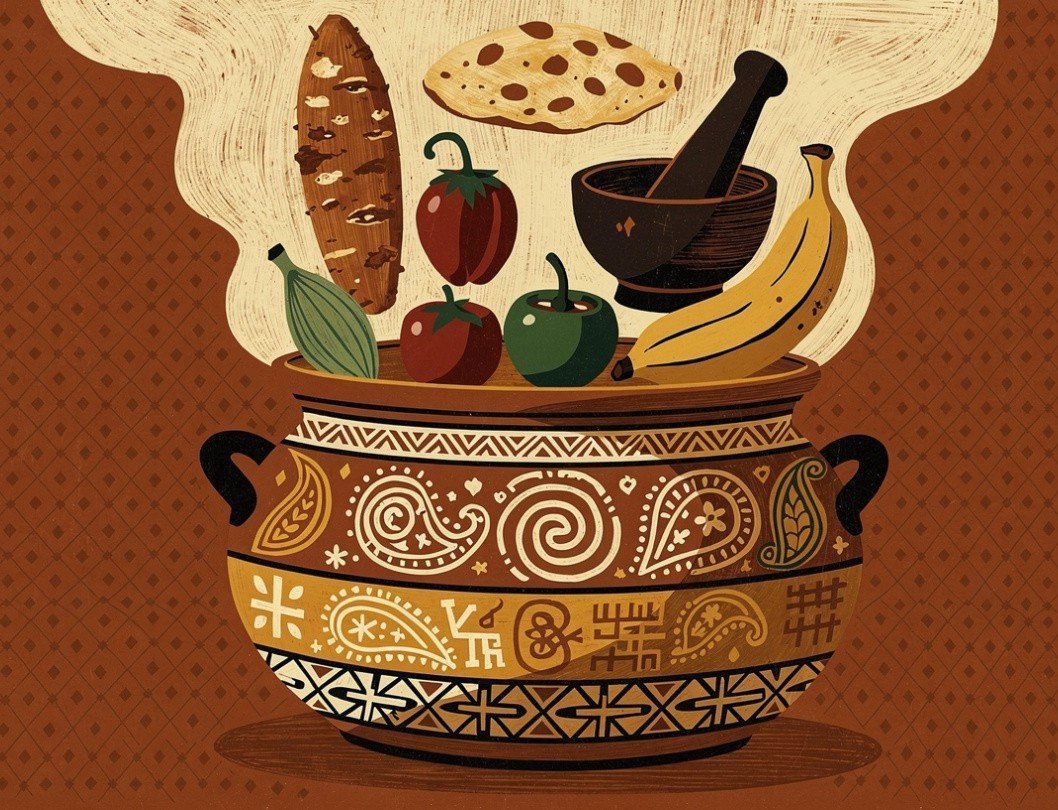
What looks like Sunday lunch is actually a history of the world in edible form. That is what Caribbean food is. And to understand it fully — to understand why it tastes the way it tastes and means what it means — you have to go back. All the way back.
Before Anyone Else Arrived: The Indigenous Kitchen
The Caribbean was not an empty paradise waiting to be “discovered.” It was a fully inhabited, agriculturally sophisticated region occupied for thousands of years by Indigenous peoples — the Taíno, the Arawak, the Kalinago (Caribs), and others — who had built complex food systems from the extraordinary biodiversity of the islands.
The Taíno people cultivated cassava (also called yuca) as their primary staple — developing the technique of pressing it into flatbread called casabe, which remains in Caribbean kitchens to this day. They grew sweet potatoes, corn, beans, squash, papaya, guava, pineapple, and a range of chilli peppers. They fished and preserved seafood using smoking techniques refined over generations.
And they gave the world something it uses every weekend without knowing the source: the word barbecue. The Taíno word barbacoa described their wooden framework for slow-smoking meat over fire — a technique the Spanish colonisers encountered, adopted, and spread globally. The barbecue in your backyard is a Taíno invention.
Sweet Potato
Corn
Papaya
Guava
Pineapple
Scotch Bonnet Pepper
Barbacoa (Barbecue)
Casabe (Cassava Bread)
By the time European colonisers arrived in the late 15th century, the Taíno population was devastated within decades — through disease, forced labour, and violence. But their food survived. Cassava, sweet potato, and the chilli pepper became foundational ingredients of global cuisine. The techniques they developed for smoking, seasoning, and fermenting food became the invisible bedrock on which everything that came after was built.
The Heartbeat of Caribbean Food: West Africa
If the Taíno provided the foundation, the enslaved Africans who were forcibly brought to the Caribbean through the transatlantic slave trade provided its heartbeat. The culinary contributions of West and Central Africa to Caribbean cuisine are so profound and so pervasive that it is not an exaggeration to say: without Africa, there is no Caribbean food as we know it.
They brought okra — the mucilaginous green pod that is the essential ingredient of callaloo and is now a global staple. They brought yams, plantains, black-eyed peas, and pigeon peas. They brought ackee — the fruit that would become Jamaica’s national dish — which originated in West Africa before being brought to Jamaica, where it now grows as though it were always native. They brought one-pot cooking techniques that are the backbone of Caribbean home cooking to this day.
But perhaps the most extraordinary contribution was not an ingredient at all. It was a philosophy of cooking — the art of making profoundly flavourful, nourishing food from whatever was available, however little that was. The enslaved were fed the parts of animals and the scraps of ingredients that their enslavers did not want: offal, pig’s trotters, pig’s tail, the tops of root vegetables, the liquid from cooking. From these, they created dishes of such depth and complexity that they are now the centrepieces of Caribbean cuisine. Souse. Pork stew. Soup. The slow-cooked, deeply seasoned, magnificently flavoured food of the Caribbean plantation kitchen was an act of genius performed under conditions of profound injustice.
Callaloo
Plantain
Yam
Ackee
Pigeon Peas
Black-Eyed Peas
One-Pot Cooking
Browning Technique
Saltfish Preparation
The enslaved were given the scraps. They turned them into a cuisine. That is not a footnote in food history — that is the story itself.
The Colonial Kitchen: Europe’s Complicated Contribution
European colonisation introduced its own ingredients and techniques to the Caribbean — some deliberately, some as side-effects of the colonial economy. The Spanish brought sugarcane from the Canary Islands, fundamentally reshaping the entire Caribbean landscape and economy. They introduced citrus trees — oranges, limes, lemons — along with ginger, tamarind, plantains (brought from the Canary Islands), date palms, and grapes. They also brought sofrito: the aromatic sauce of herbs and spices sautéed as a flavour base, first invented in Catalonia, Spain, and carried to the Caribbean in the late 1400s, where it became embedded in Cuban and Puerto Rican cuisine.
The Portuguese — though not significant colonisers of the Caribbean itself — introduced salted codfish, or saltfish, as a food for enslaved labour. It was cheap, protein-rich, and preserved well on long sea voyages. The enslaved had no choice but to make it delicious. And they did: saltfish is now a beloved staple across the Caribbean, from ackee and saltfish in Jamaica to buljol in Trinidad — proof that necessity and creativity can transform even the most practical ingredient into something extraordinary.
The British brought their pudding and pastry traditions, which absorbed into Caribbean celebrations. The French refined the creole cooking of Martinique, Guadeloupe, and Haiti with their sauce techniques. The Dutch shaped the food cultures of Suriname, Aruba, and Curaçao. Every colonial power left something in the pot.
Citrus Fruits
Tamarind
Sofrito
Saltfish / Codfish
Macaroni
Pastry Traditions
Ginger
The Spice That Changed Everything: The Indian Subcontinent
From 1845 to 1917, over 430,000 people from the Indian subcontinent arrived in the Caribbean as indentured labourers. They came primarily from the provinces of Uttar Pradesh and Bihar, crossing the Kala Pani to work on sugar estates in Trinidad, Guyana, Jamaica, Suriname, Martinique, and elsewhere. They came with almost nothing the colonial system would have considered valuable. But they carried their food culture — and that changed the Caribbean kitchen forever.
The Indian contribution to Caribbean cuisine is one of the most complete, most integrated, and most enduring of any culinary tradition. Curry — kari podi in its original form — became a foundational flavour. The spice vocabulary of the Indo-Caribbean kitchen — turmeric, cumin (called geera in Trinidad), coriander, masala blends, fenugreek, amchar (mango pickle) — is now simply the language of Caribbean cooking, used by people of every heritage on every island where Indian indentureship left its mark.
Roti arrived with the indentured and stayed. The tawa — the flat iron griddle on which roti is cooked — became as common in Trinidadian kitchens as any other implement. Dhal, the slow-cooked split pea dish that is the original comfort food of the subcontinent, is eaten across the Caribbean. And then there is the dish that may be the most complete symbol of what Caribbean food is: pelau — a one-pot rice dish whose name derives from the Central Asian polow (pilaf), brought to Trinidad by East Indian indentured workers, cooked with the African browning technique, and made with pigeon peas and coconut milk that are entirely Caribbean.
Roti
Dhal
Turmeric
Cumin / Geera
Masala
Tamarind Chutney
Channa (Chickpeas)
Amchar (Mango Pickle)
Chadon Beni / Culantro
The Quiet Influence: China and Beyond
Following emancipation in 1838, Caribbean colonies also recruited labourers from China and Madeira to fill the plantation labour gap alongside Indian indentureship. Chinese immigrants — who arrived primarily in Trinidad, Guyana, and Jamaica in the mid-to-late 19th century — brought stir-frying techniques, soy sauce, and a repertoire of vegetable preparation methods that were absorbed into Caribbean cooking.
The Chinese-Caribbean kitchen produced its own distinct hybrid tradition. Chow mein — the Chinese stir-fried noodle dish — became a Caribbean staple, adapted with local proteins and seasonings. Mustard, according to food historians, was introduced to the Caribbean by Chinese immigrants. The influence of Chinese cooking on jerk seasoning is documented: soy sauce, which some historians attribute to Chinese culinary influence in Jamaica, is a common component of modern jerk marinades.
Syrian and Lebanese merchants who settled in the Caribbean from the late 19th century onwards brought Middle Eastern flavours — flatbreads, spiced lamb preparations, and pastry traditions. Madeiran labourers contributed their own cooking culture to the mix. The Caribbean kitchen was never finished absorbing. It never closed its doors to a new flavour.
Soy Sauce
Chow Mein
Mustard
Chinese Five Spice
Middle Eastern Flatbreads
Jerk: The Most Revolutionary Food in History
No dish in the Caribbean — perhaps no dish anywhere — carries more compressed history than jerk. Its story begins before colonisation, runs through the most brutal period of Caribbean history, and ends with a flavour so powerful that it became a global culinary icon.
The foundation was Taíno. The indigenous Taíno people slow-cooked meat over pimento wood — allspice, a spice native to Jamaica — using a technique that was both a cooking method and a preservation method. When the Spanish colonised Jamaica and the Taíno population was devastated, some survivors fled into the mountains.
Then the Maroons arrived. The Maroons were escaped enslaved Africans — people who had fled the Jamaican plantations and established free communities in the island’s mountainous interior. In the mountains, they encountered the surviving Taíno communities and their techniques. The Maroons fused their own West African culinary traditions — their spice knowledge, their meat preparation methods — with what the Taíno had taught them. They needed food that could sustain warriors on long patrols without refrigeration, with minimal smoke to avoid detection by British soldiers. The result was jerk: meat rubbed with allspice (pimento), Scotch bonnet peppers, thyme, garlic, and scallions, then slow-smoked in underground pits lined with pimento wood.
The word “jerk” itself is believed to derive from the Spanish word charqui — meaning dried or cured meat — which is also the root of the English word “jerky.” Every component of jerk seasoning was a survival decision. Allspice has antimicrobial properties. Scotch bonnet’s capsaicin also helped preserve meat. The smoking sealed the surface. Jerk was not just food. It was the technology of freedom.
Doubles: The Street Food That Tells Trinidad’s Whole Story
If jerk is Jamaica’s contribution to world cuisine, doubles is Trinidad’s — and its story is equally layered. The dish consists of two soft, slightly fried bara (flatbreads) filled with curried channa (chickpeas), typically topped with tamarind sauce, mango chutney, coconut chutney, and pepper sauce. It is eaten at breakfast, late at night, after carnival, before work, at any hour and in any mood. It costs almost nothing. It is perfect.
The story of doubles begins on the indenture ships. Indian indentured labourers brought to Trinidad the tradition of channa and various flatbreads — the culinary heritage of Uttar Pradesh and Bihar, adapted over generations to the ingredients available in the Caribbean. Then, in the 1930s, in the town of Princes Town, Trinidad, a man named Emamool Deen — and by many accounts his wife Raheman Rasulan Deen — made a decision that changed Trinidadian food history forever. Instead of serving the channa on a single bara, he placed a second bara on top. The sandwich was born. He called it “doubles” — because it used two baras.
But doubles is not just an Indo-Trinidadian dish. The chadon beni — the herb that defines Trinidadian pepper sauce — is used by everyone on the island, of every heritage. The tamarind came from the trees that now grow across Trinidad, planted by multiple migrant communities. The pepper sauce carries African heat traditions and Taíno pepper cultivation. Every topping on a doubles is a different chapter of Trinidadian history. Doubles is, in miniature, the entire country on a piece of fried bread.
The Origins of Six Essential Caribbean Dishes
At a Glance — Who Brought What to the Caribbean Kitchen
| Heritage | Key Contributions | Arrived Via |
|---|---|---|
| Indigenous (Taíno, Arawak, Kalinago) | Cassava, sweet potato, scotch bonnet, papaya, guava, pineapple, corn, barbecue technique (barbacoa) | Original inhabitants — pre-European contact |
| West & Central Africa | Okra, callaloo, plantain, yam, ackee, black-eyed peas, pigeon peas, one-pot cooking, browning technique | Transatlantic slave trade, 16th–19th centuries |
| Spain | Sugarcane, citrus fruits, sofrito, ginger, tamarind, plantains (via Canary Islands) | Spanish colonial expansion, late 15th century onward |
| Portugal | Salted codfish (saltfish), bacalà traditions | Portuguese Atlantic trade routes, 16th–17th centuries |
| Britain & France | Puddings, pastry, macaroni preparations, French sauce techniques in Haitian/Martiniquais cuisine | British and French colonial rule, 17th–19th centuries |
| India (South Asia) | Curry (kari podi), roti, dhal, turmeric, cumin/geera, masala, channa, tamarind chutney, doubles | Indian indentureship, 1845–1917 |
| China | Stir-fry technique, soy sauce, chow mein, mustard | Chinese labour migration, mid-to-late 19th century |
| Syria & Lebanon | Middle Eastern flatbreads, spiced meat preparations, pastry | Merchant migration, late 19th–early 20th century |
Caribbean food is the most diverse convergence cuisine in human history. Not because of geography. Not because of luck. Because of the extraordinary, often terrible, always transformative convergence of peoples that colonialism, the slave trade, and indentureship forced onto a small group of islands in the middle of an ocean.
Every cuisine in the world has its influences and its hybrids. None has undergone the kind of complete, multilayered convergence that the Caribbean has. The food that emerged from it — callaloo and jerk and doubles and roti and pelau and ackee and saltfish — is not just delicious. It is the proof that human creativity persists even under the worst conditions. That people carry their culture with them, even when everything else is taken. That food is memory, and memory is survival.
The next time someone puts a plate of Caribbean food in front of you, remember: you are not just eating dinner. You are eating history.
Frequently Asked Questions: The History of Caribbean Food
Where does Caribbean food come from?
Caribbean food is a convergence of at least five major culinary traditions: Indigenous Caribbean (Taíno, Arawak, Kalinago), West African, European (Spanish, British, French, Portuguese, Dutch), Indian (South Asian), and Chinese. Each arrived through colonisation, the transatlantic slave trade, or indentured labour migration — and was absorbed, transformed, and made entirely Caribbean over generations.
Did the word “barbecue” come from the Caribbean?
Yes. The word barbecue derives from the Taíno word barbacoa — a wooden framework the indigenous Taíno people of the Caribbean used to slow-smoke and cook meat over fire. Spanish colonisers encountered the technique, adopted it, and spread it globally. The barbecue you host in your garden is a Taíno invention, thousands of years old.
Who invented doubles in Trinidad?
Doubles is widely credited to Emamool Deen and his wife Raheman Rasulan Deen of Princes Town, Trinidad, who created the dish in the 1930s. The dish evolved from the Indian indentured tradition of channa (curried chickpeas) and bara (fried flatbread), which Emamool Deen is said to have transformed into the two-bara sandwich now eaten by millions daily across Trinidad and the diaspora.
What is the origin of jerk seasoning?
Jerk originated in Jamaica through a fusion of Taíno and Maroon culinary traditions. The Taíno slow-smoked meat over pimento (allspice) wood with native spices. The Maroons — escaped enslaved Africans living in Jamaica’s mountains — learned these techniques and fused them with their West African cooking knowledge, creating jerk. The word comes from the Spanish charqui, meaning dried or cured meat. Jerk is not just food — it is the cooking technology of freedom.
What did African enslaved people contribute to Caribbean cuisine?
The contribution is foundational. Enslaved Africans brought okra, callaloo, plantains, yams, ackee, black-eyed peas, pigeon peas, and one-pot cooking methods. More profoundly, they brought a philosophy of cooking — transforming plantation scraps and discards into deeply flavourful food of extraordinary sophistication. Much of what defines Caribbean cuisine today — including the browning technique central to pelau and many stews — has its roots in West African culinary heritage.
What did Indian indentured labourers bring to Caribbean food?
Indian indentured labourers who arrived in the Caribbean between 1845 and 1917 brought curry (kari podi), roti, dhal, and an entire vocabulary of spice — turmeric, cumin (geera), masala blends, tamarind, and fenugreek — that now defines much of Caribbean cooking. They are the direct origin of doubles, roti shops, curry goat, and the spice-forward cooking tradition of Trinidad and Guyana in particular. Their contribution transformed the Caribbean kitchen completely.
What is pelau and where does it come from?
Pelau is a one-pot rice dish that is a cornerstone of Trinidadian cuisine. Its name derives from the Central Asian and Middle Eastern polow (pilaf), brought to Trinidad by East Indian indentured labourers in the 1800s. It is cooked using the African browning technique — caramelising sugar to impart a deep, dark flavour — with pigeon peas and coconut milk native to the Caribbean. Pelau is perhaps the single dish that best represents Trinidad’s multilayered culinary heritage in one pot.
Every Caribbean cook who has ever stood at a stove — grandmother, aunt, uncle, mother, father — has been, without perhaps knowing it in those exact words, a keeper of history. The recipes they learned were not just instructions. They were memories. They were survival. They were the record of every people who ever came to these islands and left something of themselves in the kitchen.
Caribbean food is the most diverse, most layered, most hard-won cuisine in the world. It deserves to be eaten with that knowledge, and celebrated with that gratitude.
Now go eat something magnificent. 🍛🌶️🫓